The solar system in 3D, as it is right now
The Sun and its 8 planets in order, each one exactly where it is today. Drag to turn, scroll or pinch to zoom, tap a planet to fly to it, or speed up time and watch the planets move.
Your browser has WebGL turned off, so the 3D view cannot run. The diagram and planet table below show the same solar system.
Easy view: the planets are drawn far larger than real, and distances are squeezed (square root), so everything fits on one screen. Positions, tilts and the direction every planet faces are real for the date shown.
What is the solar system?
Our solar system is the Sun and everything that orbits it: 8 planets, more than 400 moons, dwarf planets such as Pluto, Ceres and Eris, millions of asteroids, comets, and dust. It formed about 4.6 billion years ago, when a cloud of gas and dust collapsed under its own gravity. Most of it fell into the middle and became the Sun, which still holds 99.86% of all the mass. The rest flattened into a spinning disc where the planets grew, which is why they all orbit in nearly the same flat plane and in the same direction.
The four inner planets, Mercury, Venus, Earth and Mars, are small and rocky. Past the asteroid belt come the giants: Jupiter and Saturn are mostly hydrogen and helium gas, and Uranus and Neptune are ice giants, rich in water, ammonia and methane. Beyond Neptune lies the Kuiper belt of icy bodies, where Pluto lives.
Planets in order from the Sun
Mean distances from the Sun, with the live distance from Earth worked out for October 15, 2026. The Hindi names are the traditional ones used in India.
| # | Planet | From the Sun | From Earth today | Diameter | Day | Year | Moons | Temperature |
|---|---|---|---|---|---|---|---|---|
| 1 | Mercury बुध (Budh) | 0.387 au 57.9 million km | 141 million km | 4,879 km | 176 Earth days (sunrise to sunrise) | 88 days | 0 | -173 to 427 °C |
| 2 | Venus शुक्र (Shukra) | 0.723 au 108.2 million km | 43 million km | 12,104 km | 117 Earth days, spinning backwards | 225 days | 0 | 464 °C |
| 3 | Earth पृथ्वी (Prithvi) | 1 au 149.6 million km | You are here | 12,756 km | 24 hours | 365.25 days | 1 | 15 °C average |
| 4 | Mars मंगल (Mangal) | 1.524 au 227.9 million km | 233 million km | 6,792 km | 24 h 40 min | 687 days (1.9 years) | 2 | -65 °C average |
| 5 | Jupiter बृहस्पति (Brihaspati (Guru)) | 5.203 au 778.5 million km | 858 million km | 142,984 km | 9 h 56 min, the shortest day | 11.9 years | 95+ | -110 °C at the cloud tops |
| 6 | Saturn शनि (Shani) | 9.537 au 1,432 million km | 1,265 million km | 120,536 km | 10 h 39 min | 29.4 years | 274 | -140 °C at the cloud tops |
| 7 | Uranus अरुण (Arun (Uranus)) | 19.19 au 2,867 million km | 2,796 million km | 51,118 km | 17 h 14 min, spinning backwards | 84 years | 29 | -195 °C, down to -224 °C |
| 8 | Neptune वरुण (Varun (Neptune)) | 30.07 au 4,515 million km | 4,329 million km | 49,528 km | 16 h 7 min | 164.8 years | 16 | -200 °C |
Moon counts change as new small moons are confirmed: Saturn's rose to 274 in 2025 and Uranus's to 29. Sources: NASA planetary fact sheets.
Solar system facts: hottest, coldest, largest and smallest
About 464 °C everywhere, hot enough to melt lead. Its thick carbon dioxide air traps heat, so it beats Mercury, which is closer to the Sun.
The coldest temperature measured on any planet, about -224 °C. Neptune is farther out but has more inner heat.
142,984 km wide, 11 Earths across, and more than twice the mass of all the other planets put together.
4,879 km across, only a little bigger than our Moon. Pluto is smaller, but it is a dwarf planet.
274 known moons, including Titan, the only moon with a thick atmosphere.
43 million km on October 15, 2026. On average, Mercury is the nearest planet to us.
How many planets are in our solar system?
There are 8 planets in our solar system. Until 2006 schoolbooks listed 9, with Pluto as the ninth. That year the International Astronomical Union agreed that a planet must orbit the Sun, be round, and have cleared its path of other objects. Pluto shares its zone with many Kuiper belt objects, so it became a dwarf planet, together with Ceres, Eris, Haumea and Makemake. You can still find Pluto in the 3D model above, marked as a dwarf planet.
Solar system diagram and picture
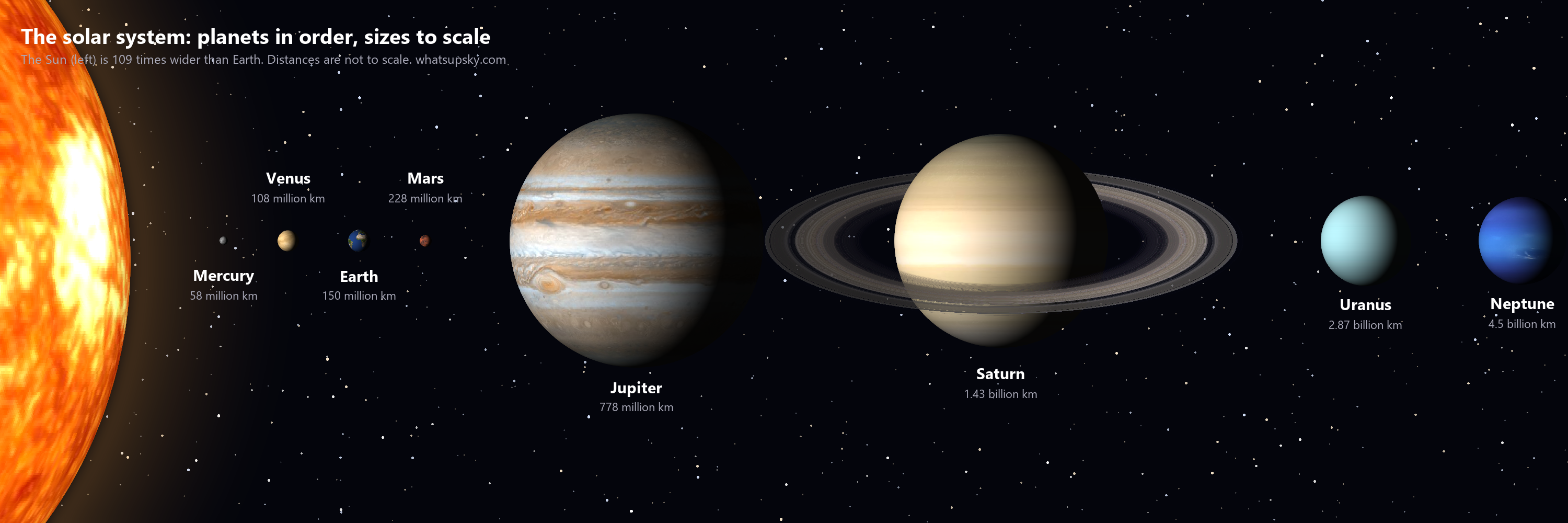
This solar system diagram shows the planets in order from the Sun, with their sizes to scale and lit from the Sun's side. The Sun is so big that only its edge fits: it is 109 times wider than Earth. Distances are not to scale; at this size Neptune would be about 1 km to the right.
Solar system drawing to print and colour
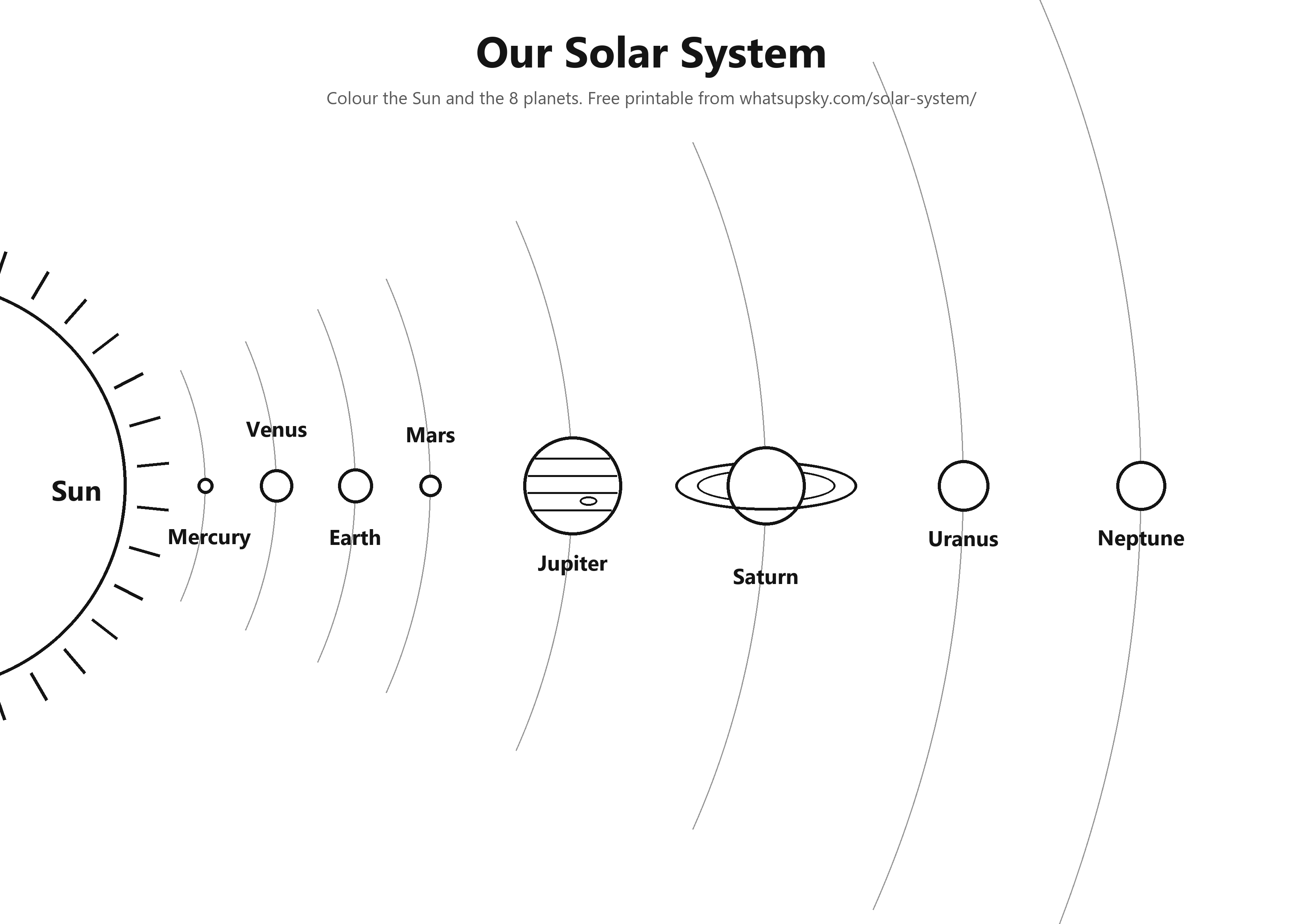
A clean line drawing of the solar system with every planet labelled, ready to print on A4 or Letter paper in landscape. Children can colour it in, and it works as the base for a school project chart.
How to draw the solar system, step by step
- Draw a big half circle on the left edge of the page for the Sun, with short lines around it for rays.
- Draw 8 curved lines (arcs) around the Sun, spaced wider and wider apart: these are the orbits.
- On each orbit draw one planet. Keep Mercury tiny, Venus and Earth a little bigger, Mars small.
- Make Jupiter the biggest circle and add stripes and a small oval for the Great Red Spot.
- Draw Saturn a bit smaller than Jupiter, with a flat oval ring across it.
- Finish with Uranus and Neptune, both medium sized, and write each planet's name.
- Colour it: Sun yellow and orange, Mercury grey, Venus pale yellow, Earth blue and green, Mars red, Jupiter cream and brown stripes, Saturn gold, Uranus light blue, Neptune deep blue.
Solar system model and project: scale calculator
Making a solar system model for school? Choose how big your Sun is and this works out the size of every planet and how far from the Sun to put it, all to the same scale. It quickly shows why most models squeeze the distances.
| Planet | Size of the ball | Distance from the Sun | Something that size |
|---|
Solar system project ideas
- Hanging mobile: paint polystyrene balls, hang them from a hoop or coat hanger in order, with Saturn's ring cut from card.
- Toilet paper scale walk: with 1 sheet = 10 million km, Mercury is at about 6 sheets, Earth at 15 and Neptune at 451 sheets. Roll it out in a long corridor or a playground.
- Clay planets to scale: if Earth is a 1 cm ball, Jupiter is 11 cm and the Sun would be a 1.1 m ball.
- Live poster: print the diagram above, then mark where each planet is tonight using the 3D model's date picker.
Snapchat solar system: the planet order explained
Snapchat+ has a "friend solar system" that shows where you rank among a friend's 8 closest friends, using the real order of the planets from the Sun. The closer your planet is to the Sun, the closer the friendship:
| Planet | Snapchat friend rank | Its real place from the Sun |
|---|---|---|
| Mercury | #1 friend | 1st planet, 0.387 au |
| Venus | #2 friend | 2nd planet, 0.723 au |
| Earth | #3 friend | 3rd planet, 1 au |
| Mars | #4 friend | 4th planet, 1.524 au |
| Jupiter | #5 friend | 5th planet, 5.203 au |
| Saturn | #6 friend | 6th planet, 9.537 au |
| Uranus | #7 friend | 7th planet, 19.19 au |
| Neptune | #8 friend | 8th planet, 30.07 au |
Snapchat's feature only borrows the order. Want to see the real planets? Fly to any of them in the model at the top of this page.
Our solar system in the night sky
You can see five planets with no telescope at all: Mercury, Venus, Mars, Jupiter and Saturn. They look like bright stars that do not twinkle, and over weeks they drift against the constellations along the same path the Sun and Moon follow, because the whole solar system is nearly flat. Find out which ones are up from your city on Planets Visible Tonight, see the bright pairings on What Planet Is Next to the Moon, and the next time several line up on Planet Parade. For the farthest human-made objects in the solar system, see the live Voyager 1 distance.
Like NASA's Eyes on the Solar System app, the model above computes real positions, but it runs instantly in any browser with nothing to install, on phones too.
सौर मंडल (Solar system in Hindi)
सौर मंडल में सूर्य और उसके चारों ओर घूमने वाले 8 ग्रह हैं। सूर्य से क्रम में ग्रह हैं: बुध, शुक्र, पृथ्वी, मंगल, बृहस्पति, शनि, अरुण (यूरेनस) और वरुण (नेप्च्यून)। सबसे बड़ा ग्रह बृहस्पति है, सबसे छोटा बुध, सबसे गर्म शुक्र और सबसे ठंडा अरुण। 2006 से प्लूटो को बौना ग्रह माना जाता है। ऊपर के 3D मॉडल में हर ग्रह आज की असली जगह पर दिखता है।
Questions people ask
What is the solar system?
The solar system is the Sun and everything held by its gravity: 8 planets, their 400 plus moons, dwarf planets such as Pluto and Ceres, millions of asteroids and comets, and dust and gas. It formed about 4.6 billion years ago from a collapsing cloud of gas, and the Sun holds 99.86% of its mass.
How many planets are in our solar system?
Eight: Mercury, Venus, Earth, Mars, Jupiter, Saturn, Uranus and Neptune. Pluto was counted as the ninth planet from 1930 until 2006, when the International Astronomical Union reclassified it as a dwarf planet because it has not cleared its orbit of other objects.
What are the planets in order from the Sun?
Mercury, Venus, Earth, Mars, Jupiter, Saturn, Uranus, Neptune. A common way to remember it: "My Very Educated Mother Just Served Us Nachos". The first four are small rocky planets; the last four are giants made mostly of gas and ice.
Which is the hottest planet in the solar system?
Venus, at about 464 °C on the surface, day and night. It is hotter than Mercury, which is closer to the Sun, because Venus has a thick carbon dioxide atmosphere that traps heat. Mercury has almost no air, so its night side cools to -173 °C.
Which is the coldest planet in the solar system?
Uranus holds the record for the coldest temperature measured on any planet, about -224 °C, even though Neptune is farther from the Sun. Uranus gives off very little internal heat. Neptune averages about -200 °C at its cloud tops.
Which is the largest planet in the solar system?
Jupiter. It is 142,984 km wide, 11 times wider than Earth, and has more than twice the mass of all the other planets combined. About 1,300 Earths would fit inside it.
Which is the smallest planet in the solar system?
Mercury, at 4,879 km across. It is only a little larger than our Moon (3,474 km) and smaller than Jupiter's moon Ganymede and Saturn's moon Titan. Pluto is smaller still, but it is a dwarf planet.
Which planet is closest to Earth?
It changes. Right now (October 15, 2026) the closest planet to Earth is Venus, about 43 million km away. On average over time, Mercury is the closest planet to Earth, because it never goes far from the Sun, while Venus comes nearest at its closest approach.
What is the Snapchat solar system?
A Snapchat+ feature that shows where you rank among a friend's 8 closest friends, using the planets in order from the Sun. If you are Mercury you are number 1, Venus number 2, Earth 3, Mars 4, Jupiter 5, Saturn 6, Uranus 7 and Neptune 8. It only uses the planet order; the order itself is the real one from the Sun outward.
How big is the solar system?
The planets end with Neptune at 30 au (4.5 billion km). The Kuiper belt reaches about 50 au, the Sun's wind bubble (the heliopause) about 120 au, where Voyager 1 left it in 2012, and the Oort cloud of comets may stretch to 100,000 au, more than a light-year.
Is this 3D solar system model accurate?
The positions are real: every planet sits where it actually is on the date shown, worked out with the VSOP87 planetary theory used by planetarium software, and each planet's tilt and spin come from the IAU rotation model. In Easy view the sizes and distances are squeezed so everything fits; switch the Scale menu to "True distances and true sizes" to see the real proportions.
Where can I get a solar system diagram?
On this page: the solar system diagram above shows the Sun and the 8 planets in order, with their sizes to scale and the distance of each from the Sun. Download it free as a full size PNG for a project, poster or worksheet, or print the black and white drawing to label and colour. For a diagram of where the planets are on any date, use the 3D model and press Download this view.
Can I use the solar system pictures for a school project?
Yes. The planet diagram and the colouring drawing on this page are free to download and print for school projects and posters. The planet textures come from Solar System Scope (CC BY 4.0, based on NASA data), so please credit "whatsupsky.com and Solar System Scope" if you publish them.
How do I make a solar system model for a school project?
Pick a size for the Sun, then use the scale calculator on this page to get the size of each planet and how far apart to place them. For a table-top model use balls for the planets and ignore the distances; for a true-scale walk, use a small Sun (a 20 cm ball) and you will need about 2 km of space to reach Neptune.
Can I see the planets from Earth?
Five planets are easy to see with your eyes alone: Mercury, Venus, Mars, Jupiter and Saturn. Uranus is just at the limit of eyesight from a very dark site, and Neptune needs binoculars. See which ones are up tonight from your city on our Planets Visible Tonight page.